
Bilou, the mentawai Gibbon observed in Saguruju customary forest
By: Arif Setiawan, Aloysius Yoyok, Nur Aoliya, Kurnia Latifiana, Kurnia Ahmaddin,
The bilou, the endemic gibbon of the Mentawai Islands ( Hylobates klosii ), is unlike any other animal. It is part of the Mentawai people’s story. Its early morning call signifies the forest’s survival. Mentawaians believe that if a bilou calls in the early morning, it signals a bad omen, such as a death or an impending disaster. If the call is gone, where will we learn about these natural omens? If we know how many bilou are left, we can ensure the forest remains healthy, as bilou help disperse tree seeds and maintain the balance of nature.
If we don’t count the population, we don’t know whether the bilou are dwindling or whether they are still safe. Population is the number of individuals occupying a specific area of habitat. It’s like counting the number of children in a village: if there are fewer, we worry about the village’s future being deserted. The same is true for bilou—if their population declines, it’s a sign that our forests are ailing.
What are the Benefits for us:
– Know the condition of the forest: lots of bilou = healthy forest.
– Preserving cultural heritage: bilou is part of Mentawai identity.
– Attracting global attention: population data can help gain support for protecting forests.
– Ensuring the future: our children and grandchildren can still hear the sound of the bilou in the forest.
So, counting the bilou population isn’t just about numbers. It’s how we protect our shared home, ensure the forest remains alive, and preserve the Mentawai story.
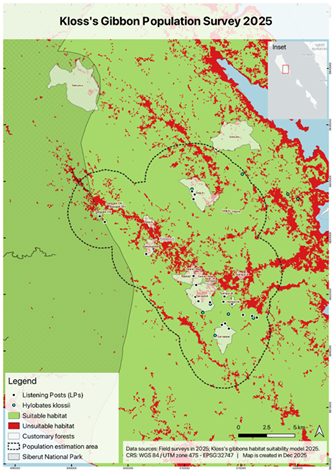
Location map of the bilou survey on triangulastion set locations
The Siripok Bilou team, formed in early 2025, successfully conducted a survey to estimate the number of bilou in selected areas on Siberut. We surveyed nine customary forest areas based on recommendations from the local Citra Mandiri Foundation. Using the vocal count-triangulation survey method, the survey was conducted based on bilou sounds. Observers conducted the survey using a triangulation system (three observation points in different locations, with a distance of 300-500 meters between them). These three points were then repeated for four consecutive days to listen and estimate the distance. The assumption was that the same group would vocalize at the same location for four consecutive days.
Population analysis was conducted using the same point count formula used in previous Bilou population estimates (Setiawan et al. 2020; Whittaker et al. 1995). To determine the area, we used a habitat suitability analysis, which can be read here: https://swaraowa.blogspot.com/2025/12/dimana-bilou-bersuara-pemetaan-habitat.html

Mentawai bilou population calculation table in 2025
From the population analysis that we conducted, the estimated population of bilou in the customary forest area in South Siberut (11 locations) with an area of approximately 208.64 km 2 is approximately 396 individuals consisting of 146 (96-186) groups.
These results are preliminary from a survey that will be conducted throughout Mentawai and are subject to change based on the latest information obtained from field teams that have, are, or will conduct surveys at other locations in the Mentawai Islands. For discussions regarding this analysis, please contact [email protected].