by Arif Setiawan.
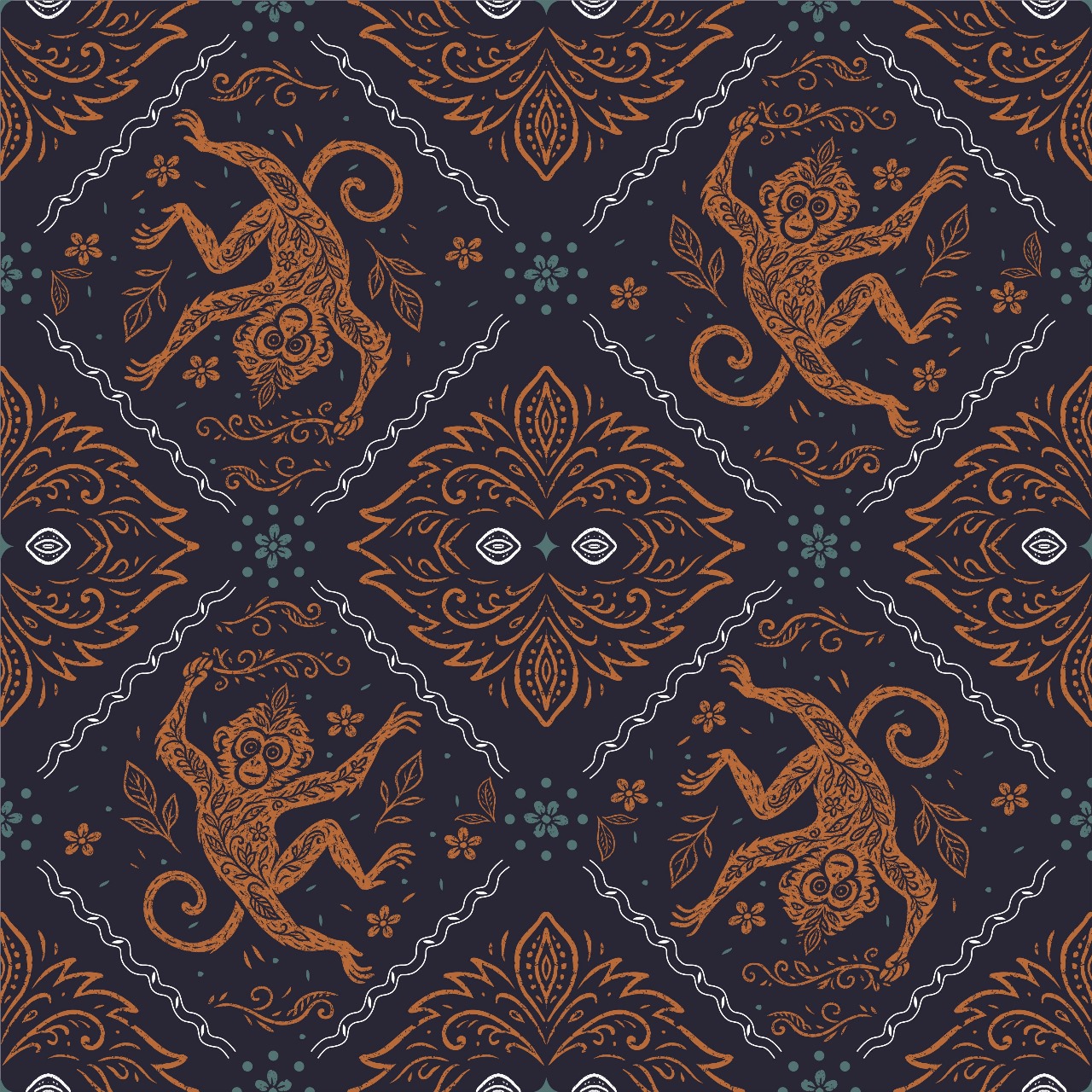
When designing the *Owa* (gibbon) batik motif last year with my friend Faiz Alymy, the idea arose to highlight various Indonesian primate species. We sought to combine natural imagery—specifically the forest—with classic batik pattern concepts.We named this second motif “Wanara.”
Reviving the Archipelago’s Leaf-Eating Monkeys
The visual inspiration for this piece is rooted in Indonesia’s biodiversity, specifically the *Presbytis* genus—a group of leaf-eating primates (folivores). Examples include the *Rekrekan* (Presbytis fredericae) in Central Java, the *Simpai* (Presbytis melalophos) in Sumatra, and the *Kelasi* (Presbytis rubicunda) and *Bekantan* (*Nasalis larvatus*) in Kalimantan. These species possess distinctive characteristics, and their natural distribution represents the biodiversity of the western archipelago (Java, Kalimantan, and Sumatra). There are even endemic species on smaller islands, such as the *Simakobu* (Simias concolor) and *Joja* (*Presbytis potenziani*) in the Mentawai Islands, the *Kekah* (Presbytis natunae) in Natuna, and (Presbytis siamensis) in Bintan.
Unlike modern, hyper-realistic illustration approaches, the *Presbytis* figure here is rendered through the stylized aesthetics of classical Solo (Surakarta) art. The lines of its body are fluid and undulating, capturing the active, arboreal nature of these primates as they move through the forest canopy, while their distinctive crests are highlighted as a key morphological feature. The *isen-isen* (intricate interior fill patterns) depicting foliage—which envelop the monkey’s anatomy—explicitly underscore the symbiotic relationship between this animal and its natural habitat.
Rooted in the *Sido Luhur* Tradition
Structurally, the design is built upon the foundation of the *Sido Luhur* pattern—a classic royal batik motif rich in symbolic meaning. The word *sido* signifies “becoming” or “continuity,” while *luhur* symbolizes nobility of character, glory, and an honorable life.
A diamond-shaped geometric frame, combined with a central motif, creates a majestic spatial balance. The undulating lines framing the pattern accentuate the classic Surakarta aesthetic—graceful, orderly, and rich in transcendental meaning.
Why “Wanara”?
Literally, the Sanskrit term *Wanara* refers to a race of apes or monkeys, characterized by their tails. Yet, within the universe of the *Ramayana*—the epic that serves as the soul of many *wayang* (shadow puppet) performances—the *Wanara* symbolize agility, loyalty, and the innate intelligence that maintains the balance of the cosmos.
Through this name, the *Wanara* batik motif serves not merely as a depiction of wildlife, but as a tribute to local wisdom and the preservation of the natural world, interwoven with a prayer for a noble life.
Celebrating Colobine Day 2026
Batik has always been a powerful medium for storytelling. Through the *Wanara* batik motif, I hope Colobine Day 2026 , August 25, is celebrated not only as a moment of global environmental awareness but also from within our own cultural roots. It aims to inspire nature conservationists to preserve Indonesia’s native monkey species, highlighting that respect for nature, nobility of character, and the preservation of primate habitats have long been harmoniously woven into the philosophy of Indonesian attire.
Translated from original article published here : https://swaraowa.blogspot.com/2026/08/motif-batik-wanara-harmoni-filosofi.html