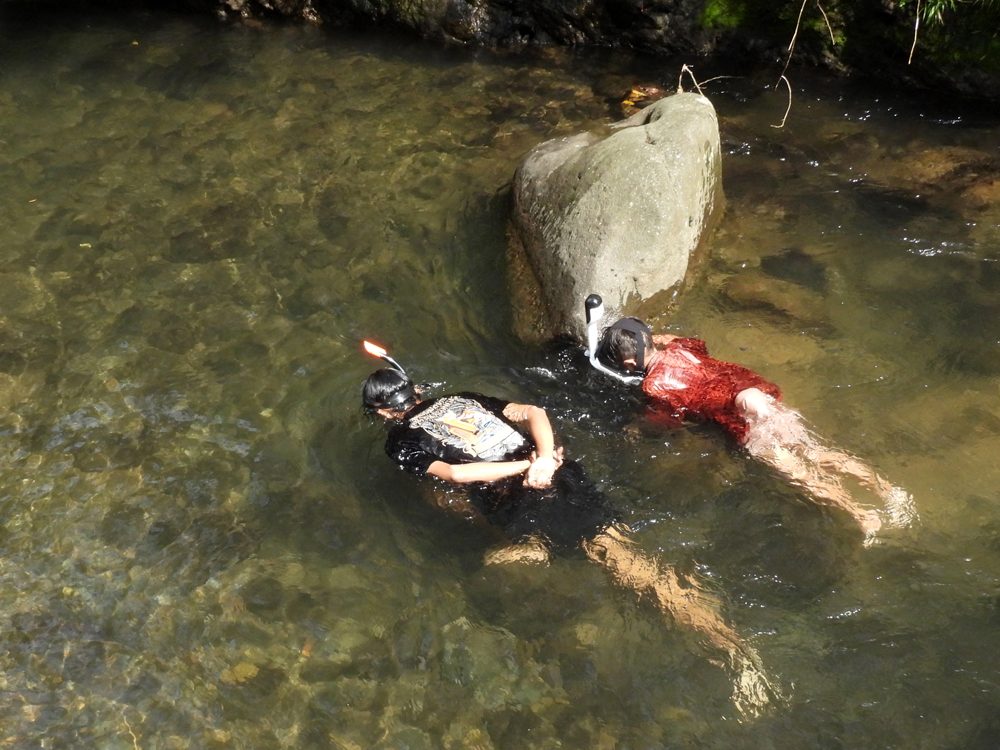
fish watching at the Wisnu River, Mendolo
By: Imam Taufiqurrahman
An unusual sight was witnessed at Kedung Kali Bengang, Wisnu River, on May 23-24, 2026. A group of young men and children from Sawahan Hamlet, Mendolo Village, filled the area of the pool. Some, wearing goggles and snorkels, were seen immersing themselves in the clear river current. They were engrossed in fish watching .
A group of ragalan became their target. The medium- to large-sized inhabitants of the pool swam nimbly in the clear water, constantly avoiding children who tried to approach them.
“Don’t chase them, let them be,” warned Mr. Irwanjasmoro, the resource person and instructor for the activity. “Just wait,” he continued, “and let the fish come to you on their own.”
The children were so enthusiastic that they splashed around trying to get closer. Then, they realized that chasing after her was futile.
They were overly enthusiastic. This was because they were unfamiliar with fish watching . It was their first time observing fish from below the river. Their instinct was to chase, as if they wanted to catch them. In fact, by remaining still, the fish would approach.
Just like snorkeling in the ocean, watching fish in a river is apparently just as exciting. And we all know that simply swimming or playing in the water is enjoyable enough.
Meanwhile, fish watching offers a completely different experience. Submerging your face, breathing with a snorkel, and listening to the roaring breaths is quite a unique experience.
Not to mention those who usually only see fish from the river surface. Typically, ragalan or Tor tambra are only seen from the road or bridge, welcoming anyone entering Sawahan Hamlet. Fish watching allows us to swim with them, following their movements in the depths, occasionally catching them at eye level.
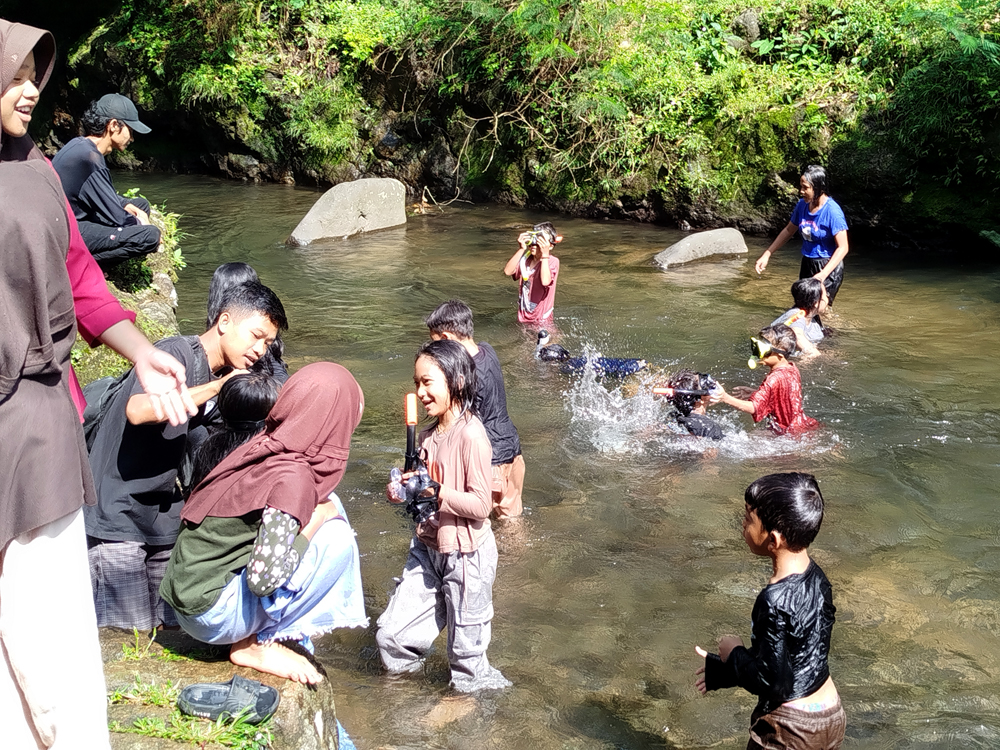
fish observation participants, children, teenagers and adults
As time went on, the children seemed to calm down. They willingly took turns using the snorkels, patiently lining up at the riverbank. Some simply watched, while others joined in to catch fish for their friends.
The river flow felt very cool. Those unaccustomed to it might quickly feel cold. However, the children seemed perfectly normal. They spread out to find their respective observation points.
The young men, who had received training and tried fish watching on the first day, continued to accompany and guide their younger siblings, 17 elementary and junior high school-aged children. They helped the children put on snorkels, accompanied them in their fishing trips, and kept an eye on the others.
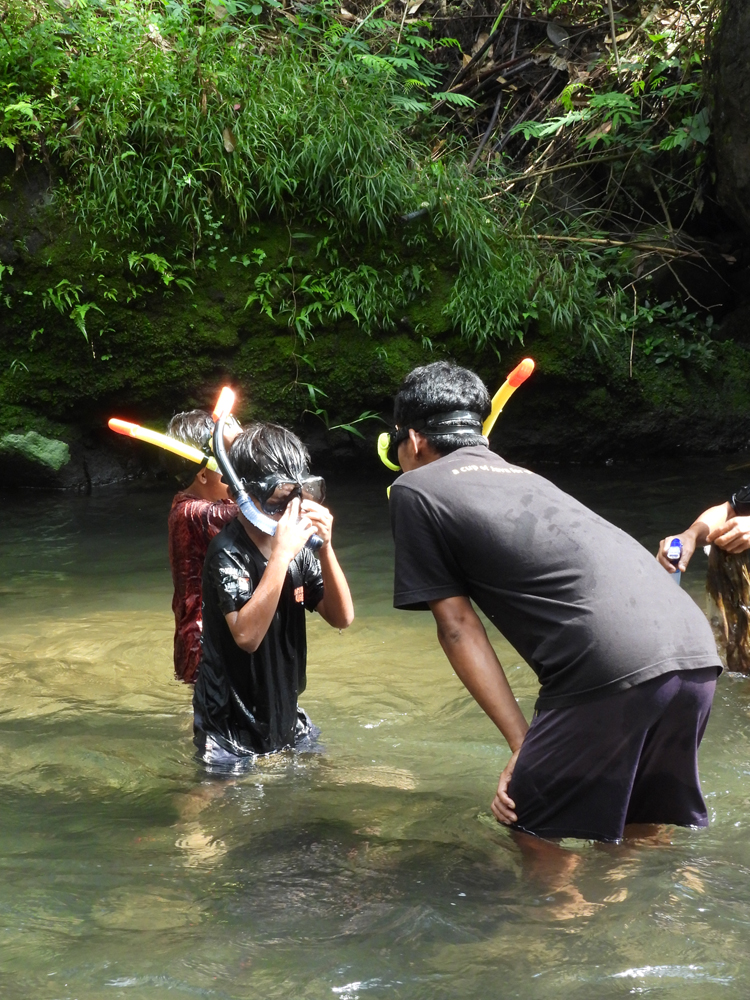
Children are guided using diving goggles and snorkels.
As time went on, they seemed to be enjoying themselves more and more. They displayed various poses: lying face down on rocks, crouching in the water, or walking with their heads bent. As the dry season approaches, the depth and current of the Wisnu River are considered safe and ideal. The current is shallow and not very deep, with a moderate current speed.
A little downstream, on the edge of the river full of rocks and shallow pools, Mr. Irwan found another fish.
“Here, there’s a sili ,” he said.
The long, flat, eel-like fish hid beneath the rocks. Its head protruded, revealing its snouted mouth. Its back and tail dangled from the rocks on the riverbed. Without a careful eye, the fish, with its unique pattern, scientifically known as Macrognathus maculatus, would have been invisible.
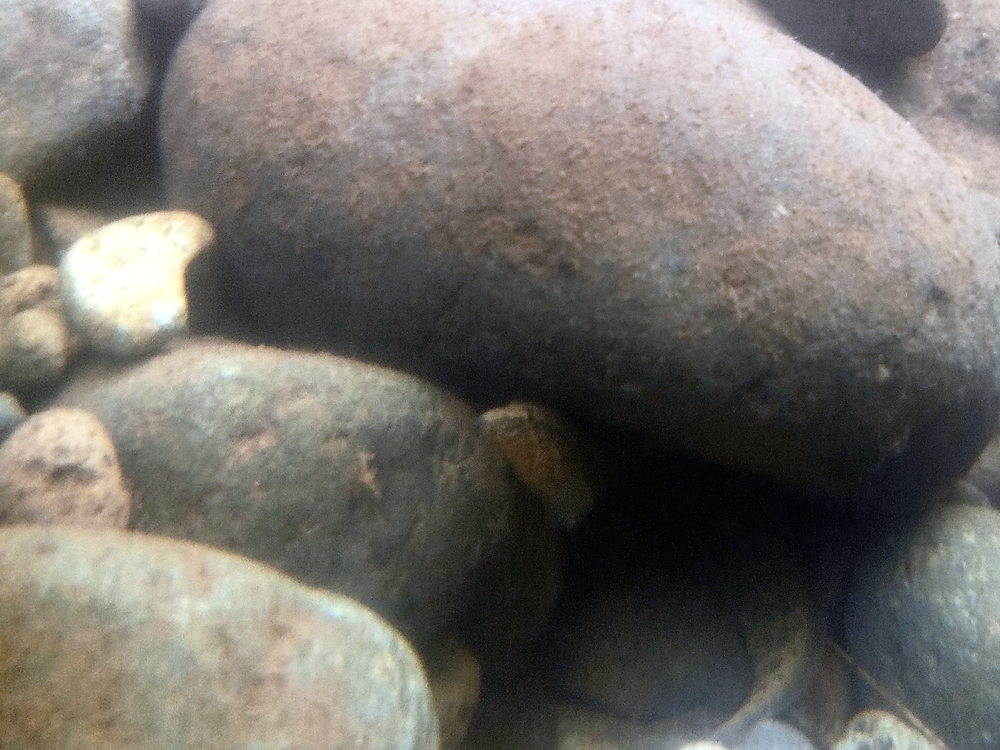
Sili observed hiding in the rocks
Typically, sili inhabit fast-flowing pools with surfaces covered in ripples and foam. Unless caught with a fishing rod, they’re very difficult to find. Luckily, this time, it was nestled among the shallow rocks.
Not far away, it was the bokol’s turn to be spotted. This species, common in the Wisnu River and in Java’s freshwaters, swam along the riverbanks. Its scientific name is Barbodes binotatus . There was also the lunjar , a type of wader with a blue side stripe. According to Mr. Irwan, these species in the genus Rasbora sp. still require in-depth study due to their similarities.
Riki, who had been observing the area under the bridge, came to the surface.
“There is a kékél ,” he said.
Several children then approached the rocks Riki pointed to. They immediately submerged themselves, searching for the Javanese endemic, which at first glance resembles a catfish. The difference is that this fish, scientifically known as Glypthotorax platypogon, has an adhesive organ on its chest that allows it to cling to rocks in strong currents.
Fish watching as ecotourism
Before they knew it, the children had been soaking in the river for almost two hours. Although they seemed dissatisfied, the activity had to be stopped. Four of the seven species of fish in the Wisnu River were observed. If they were more persistent, they might have spotted other species, like the uceng .
Indeed, this kind of freshwater fish watching activity is far from popular, perhaps even virtually unknown. Unlike similar underwater activities, snorkeling seems to be synonymous with it.
However, observing freshwater fish in their natural habitat can be packaged as a recreational activity, even ecotourism. It’s a unique way to introduce the diversity of local fish species and encourage people to care more about the sustainability of rivers and the fish species that live there.
Fish watching is a further way to protect and preserve freshwater fish. This activity on the Wisnu River was proposed at a river workshop and discussion in Sawahan Hamlet in 2025. Mr. Irwan, who was present, introduced the activity, which he had previously piloted in Yogyakarta.
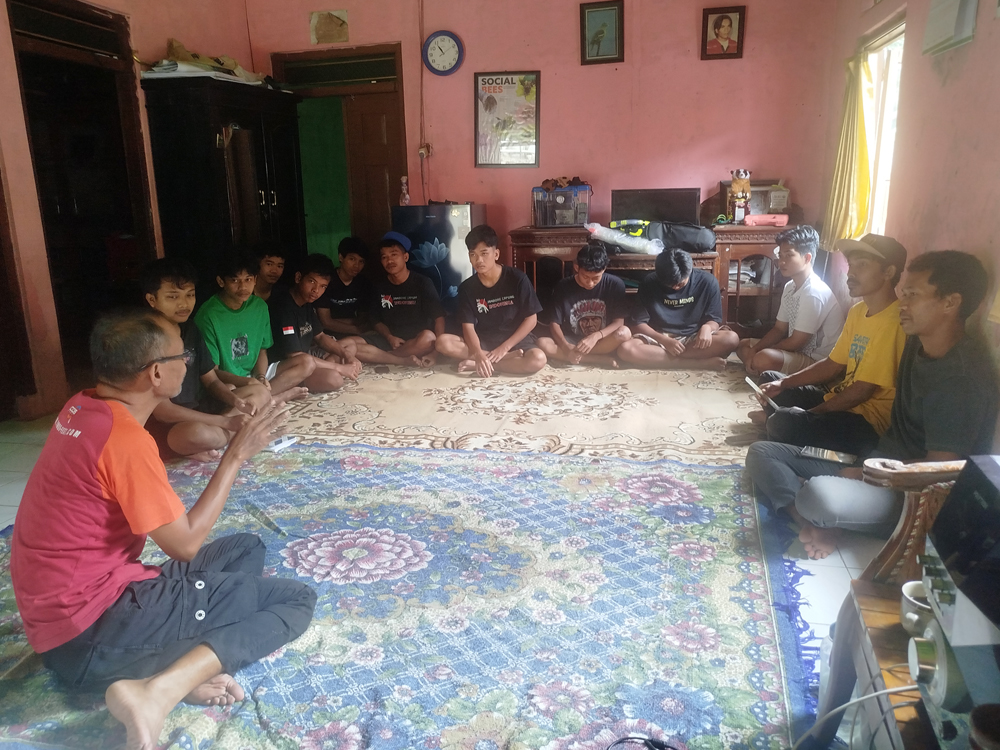
Discussion and sharing with young people before the first fish watching activity, May 23, 2026
Developing fish watching as ecotourism is very possible in the Wisnu River. The people of Sawahan Hamlet have long abandoned unsustainable practices in river and fish utilization. In the past, the dry season was the best time for the Sawahan Hamlet community to practice the “tradition” of poisoning, or ngobat . Now, during the dry season, fish watching is the practice. Kedung Kali Bengang has become a sanctuary for ragalan and other fish. It is a forbidden pool that deserves future development. The return of ragalan is proof of the success of years of protection efforts, which have been stipulated in a joint agreement. Careful planning is indeed essential and must be a primary concern in developing special interest fish watching ecotourism .
The upstream looked cloudy. Several young men on duty monitoring the river warned people to stop. And sure enough, it started raining soon after.
The children returned home to change. They gathered again to discuss the results of their activities while enjoying lunch. The initial phase of introducing fish watching to the youth and children of Sawahan Hamlet was complete. They agreed to fish watching again another time. Interested in trying it out?
(translated from original article published in blog :https://swaraowa.blogspot.com/2026/08/sensasi-seru-fish-watching-di-kali-wisnu.html )