by : Arif Setiawan
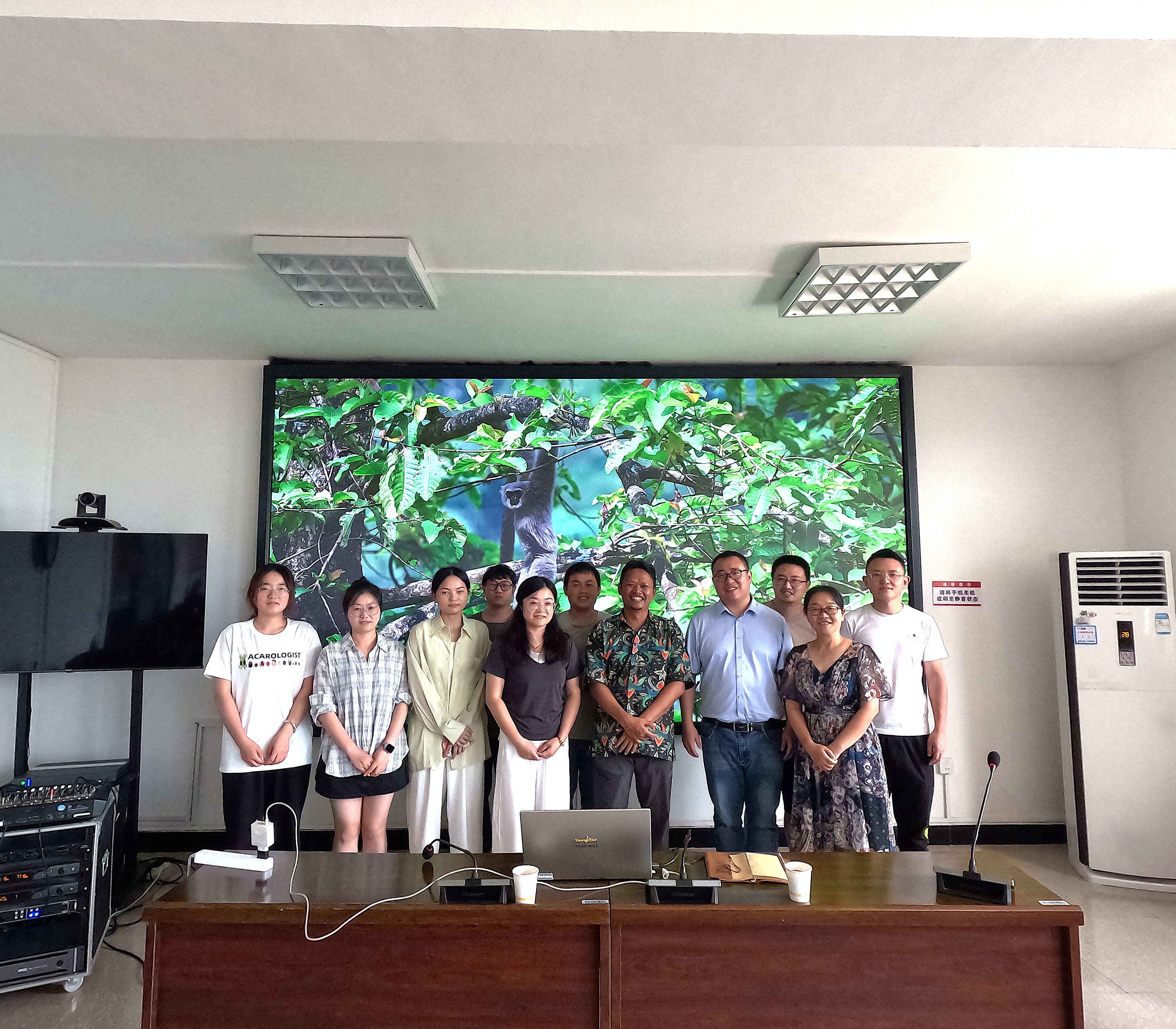
photo group at Guizhou Academy of Science
August 6, 2025 Guiyang, the capital of Guizhou Province—a city that defies stereotypes about China’s mountainous regions. Here, skyscrapers rise as if to touch the clouds, forming a modern silhouette that contrasts with the surrounding valleys and hills. The streets are busy with traffic and people, and the economic pulse is palpable on every corner: from glitzy shopping malls to small, never-ending stalls.
I visited this city at the invitation of Kefeng Niu, a primatologist I have known for a long time since 2011, from a course in Singapore. Kefeng is a researcher of the Guizhou Snub-Nosed Monkey (Rhinopithecus brelichi), a monkey endemic to Mount Fanjing-Guizhou.
A few days before arriving in Guiyang, I visited the Guizhou monkey breeding center located at the foot of Mount Fanjing. There are three species of snub-nosed monkey in China, and the Guizhou snub-nosed monkey is the smallest. Its population is around 400-700 individuals, even listed as Critically Endangered by the IUCN Red List, with only 200 mature individuals. Therefore, a breeding center has been established for this Guizhou mascot. This research and breeding center was established in 1993, starting with seven wild-caught individuals as colony founders. This step was taken because the wild population was very small and fragmented, so an ex-situ conservation strategy was needed to prevent extinction. Since 1995, this program has begun to show success with the birth of new individuals every year, marking the beginning of a more systematic management of the captive population.

Guizhou snub nosed monkey- at breeding center
The journey took approximately 1.5 hours from our hotel in Jiangkou City to the breeding center, located in a valley surrounded by densely forested mountains and flowing with crystal clear water. At the gate, Kefeng’s friends, who had previously assisted him in his research and were now staff members, were waiting. We immediately went inside, even though it was in captivity, as this was our first time seeing one. At first glance, it was impressive: it looked larger than the largest Javan langur I’d ever seen. Its face was pale blue with a pink hue, and its snub nose was very strange. Its feet appeared larger and longer than its body, and its long, rounded tail seemed to hang down longer than its legs, dark black-long hair on the back, white tip on the ears and few white hairs longer in the lower back of the head.

white tip on ears and creamy white long hairs at the back

Juvenile guizhou snub nosed monkey
There was one male, the first to be seen , two females, and one juvenile. According to Kefeng, there are seven individuals in total in the breeding center. The facility is not open to general tourism; however, for conservation purposes, researchers are welcome to visit the breeding center.
Snub-nosed, translated as “hidung pesek,” in bahasa, is the Guizhou monkey, which appears to have a hole without a nosal bridge, looking odd. This is certainly related to its evolutionary adaptation to the cold, dry air in the mountains. Its long, thick fur also indicates an adaptation to cold temperatures.

cable way view : fanjingshan mt habitat of guizhou snub nosed monkey
After seeing the Guizhou snub-nosed monkey in captivity, we headed to the entrance to trek to Mount Fanjing, also the natural habitat of the Guizhou snub-nosed monkey. This area is a nature reserve, a UNESCO heritage site, and the most popular tourist destination in Guizhou Province, using the Cable Car. Built with environmentally friendly technology and a design that blends with the natural contours, this infrastructure opens access to a conservation area previously only accessible to researchers and climbers. The cable car has become a symbol of the harmony between development and conservation, part of China’s ecotourism strategy that combines endangered species conservation with world-class tourism experiences. At the final station, visitors can access an education center, interpretive trails, and a primate observatory designed to bring together natural science, geological history, culture, and a sense of wonder.
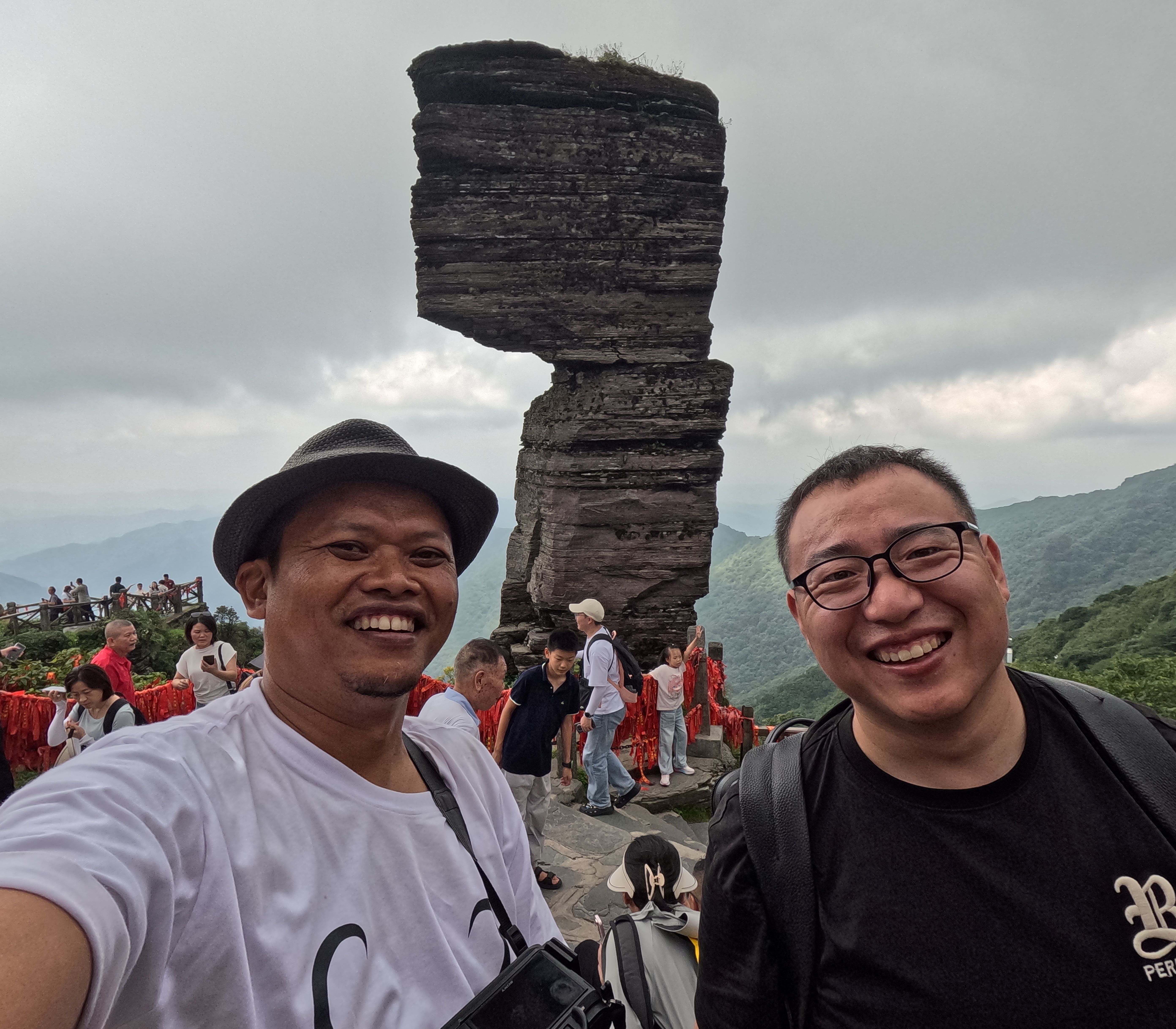
with Kefeng infront of legendary mushroom rock Fanjing mt.
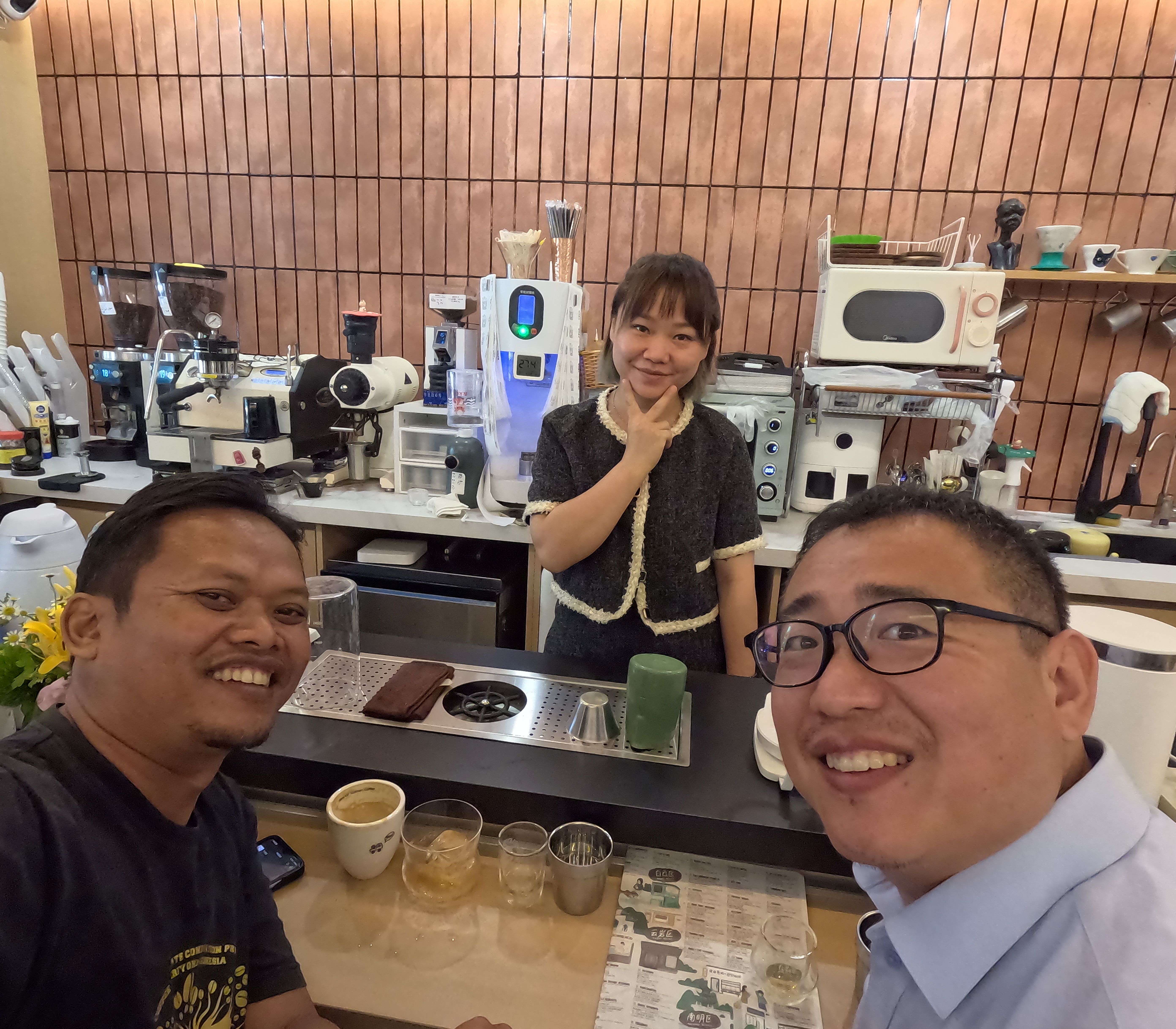
coffee talk at San men coffee Guiyang
In Guiyang City, I visited several coffee shops. According to a flyer I found in one of the shops, there are approximately 3,000. One I visited was “San Men Coffee”, which I found through an online search, and fortunately, the owner was the barista. We chatted extensively about the coffee business in Guiyang and the characteristics of coffee drinkers here. IShe said that in hot weather like now, cold brew and coffee with milk are popular, and delivery or online orders usually outnumber in-store orders. The shop is small, measuring 2 x 5 meters, but it looks very busy. Several collections of coffee beans are displayed in front, some from Sumatra. Others come from South America and Africa. He said they can produce 150-300 cups a day. and offcourse I talk to her about our gibbon conservation coffee “Owa Coffee”.
Guiyang is a growing city, but it hasn’t forgotten its roots. It’s building for the future while preserving its heritage. On campuses and innovation centers, young people are designing locally-based solutions.
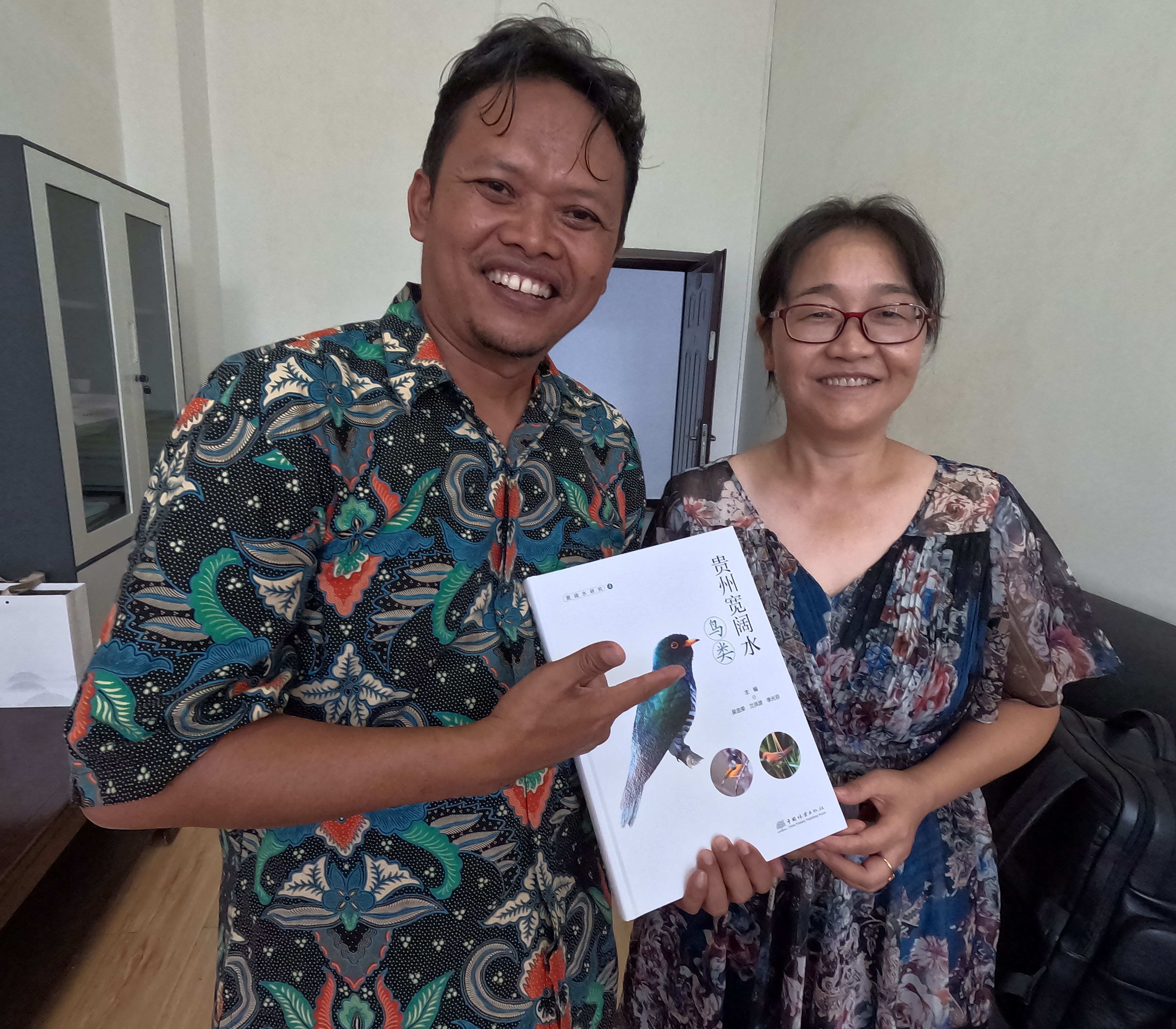
bird book by Prof. Zhongrong Wu
In this vast green area, nature remains a teacher and protector. I received an invitation to one of the province’s science development centers, the Guiyang Academy of Science. This opportunity arose because Kefeng Niu, who works at this institution, presented at the Guiyang Academy of Science. The opportunity to introduce the Javan Gibbon and its conservation project in Pekalongan, Central Java. Kefeng had arranged everything, and after lunch we headed to the Guiyang Academy of Science. There we were awaited by Professor Man Liu and Professor Zhongrong, who are entomologists and ornithologists. The presentation room had been prepared and the participants were researchers at this institution, similar to BRIN in Indonesia. I presented the Coffee and Primate Conservation project in English, and I must thank Kefeng for helping translate into Chinese. The presentation went smoothly, and received many appreciative questions from those present. After the presentation, I was invited to Professor Man Liu’s room, where I received a souvenir of a preserved insect, which he said was a rare species, and reached adulthood, as pictured in this frame, within two years. I had the opportunity to give her a pack of Owa Coffee.

Owa Coffee for Prof. Man Liu
Then, Prof. Zhongrong Wu, a bird researcher, gave me a book containing his research on bird species. The book, which was so thick and so special, was given to me and signed by the author.After my presentation at the Guizhou Academy of Science, Kefeng took me to the city park, but it was incredibly crowded.

Macaca mulata-medium long taile macaque
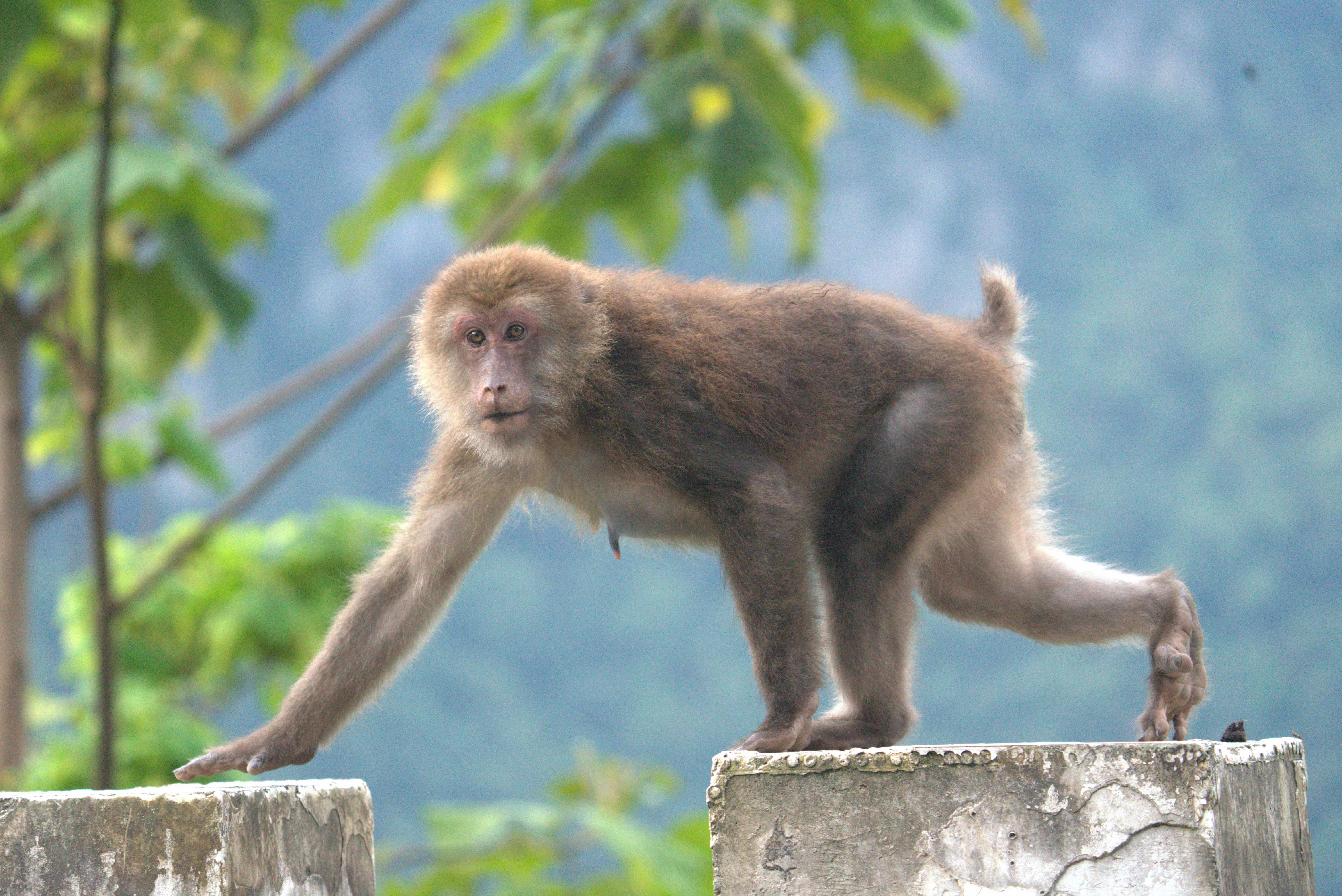
Macaca thibetana-shortest tailed macaque
This summer vacation has made Guiyang a bustling city! We actually wanted to see a semi-wild monkey species here: the Rhesus Macaque (Macaca mulata). It’s the third species of monkey in southwest China. The dense crowd made it difficult to observe the surroundings. It’s actually a park, but it’s very large and forest-like. Then, a group of monkeys started causing a commotion by stealing food brought by visitors. Yes, that’s my lifer, the Macaca mulata. Its characteristics are almost the same as the common macaque, but its tail isn’t as long as the fascicularis macaque, and is longer than the Tibetan macaque’s ( Macaca thibethana), that also have seen them day before in Fanjingshan. That’s all there is to it, and there weren’t many photos because the crowds were getting crowded and I couldn’t focus on observing or following the monkeys. Kefeng took us outside, saying that as a Chinese person, he had never seen so many people in a city park.
That day, we ended with dinner with colleagues and government officials, who were designing a joint research and conservation project. I just ate along, not understanding what was being said. But it was a different experience with my new colleagues in China—a pleasant and satisfying social dinner.
August 7, 2025, Adventure in China is over, I left back to Jakarta, and almost missed the plane, because suddenly the schedule was changed, canceled and suddenly I had to change planes, and luckily there were still seats left, because I had to transit in Sensen, so there was a connecting flight that had to go to Jakarta, I could also have missed it because of this change. Arriving in Zensen the plane was right on schedule with the next plane, I ran through immigration and was very helped by the officers. Finally, my watch was on the plane to Jakarta. Goodbye Guizhou. Xie-Xie.