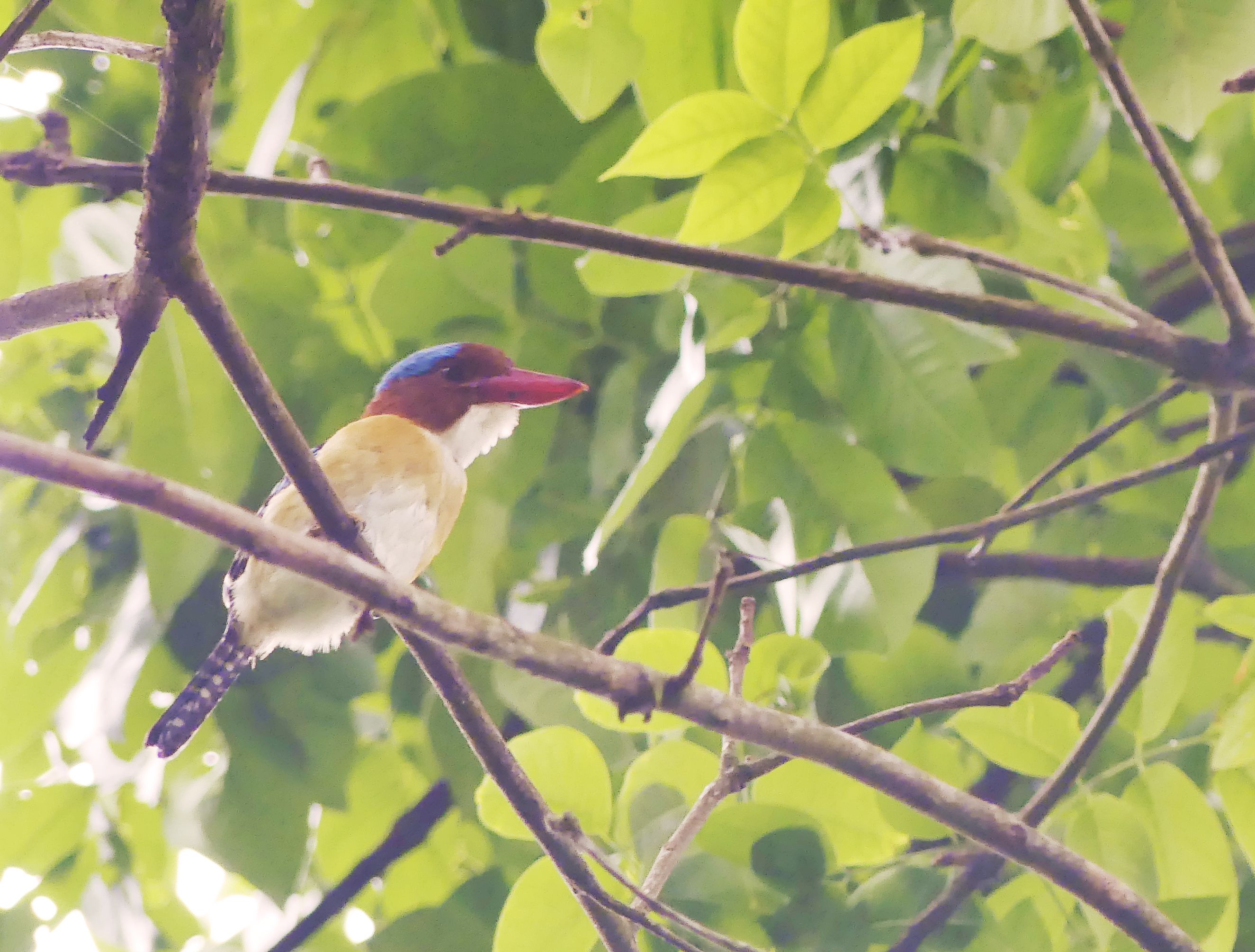
Lacedo pulchella- a kingfisher inhabits habitats with dense vegetation and shade
By: Sidiq Harjanto & Muhammad Kuswoto
This trip felt complete for us: traversing dozens of kilometers of winding, steep roads, tasting coffee, birds watching, hearing stories about civets, and sharing our concerns with farmers. This is our story of touring the villages supporting the Javan gibbon habitat in the Petungkriyono Landscape. We met with partner farmers involved in the “Owa Coffee: the guardian of the gibbon” program to monitor their progress.
This program, managed by SwaraOwa and supported by the AirAsia Foundation, seeks to improve the economic well-being of coffee farmers while ensuring the preservation of habitats for diverse wildlife. Over four days of traveling, we visited ten locations and met twenty-five farmers—reaping countless new experiences. However, the question remains: can coffee be the savior of the Javan Gibbon?
Non-linear living space
A loud bird call greeted us at Baiduri’s (44) garden in Jalatiga Village, Talun District. The call sounded distinctive, although we couldn’t yet determine the species of bird it was coming from. It turned out to be right above us. I aimed the camera to take some pictures. On a tree branch, a bird was perched, identified as a kingfisher ( Lacedo pulchella ). This bird belongs to the kingfisher group, from the Halcyonidae family.
According to a report by Imam Taufiqurrahman and Kurnia Ahmadin in the book “Birds of Petungkriyono & Lebakbarang: Diversity, Threats, and Conservation Efforts,” published by SwaraOwa last year, this species inhabits habitats with dense vegetation and shade. Although its distribution is quite common in the studied landscape, the kingfisher requires a specific habitat.
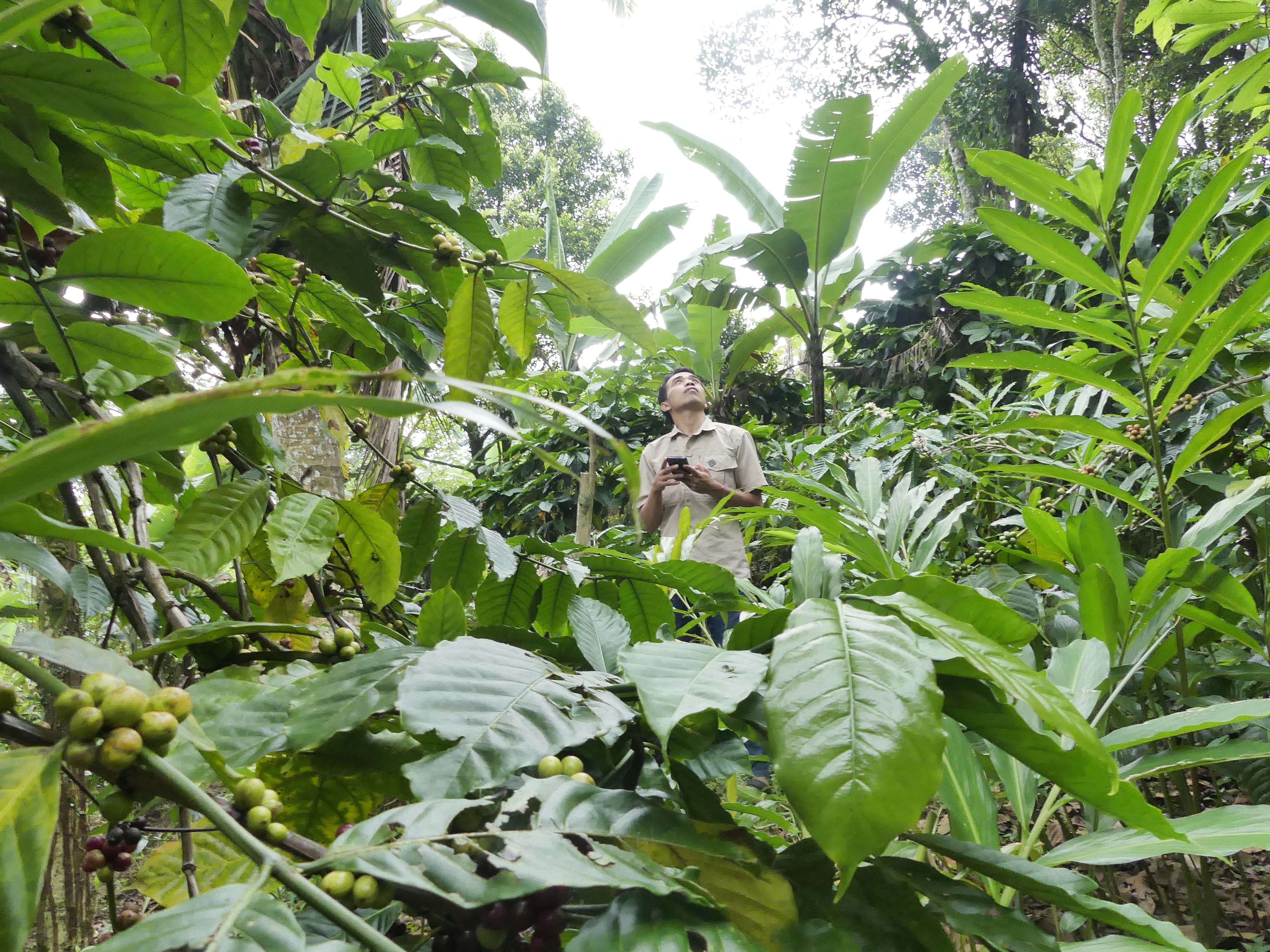
coffee agro-forest habitat
Less than a hundred meters from the village, Baiduri’s land, less than 1,000 square meters in size, is shaded by large mahogany trees. This management model could be called complex agroforestry—composed of dozens of commodity crops, from spices and fruits to food crops. Coffee, cocoa (chocolate), avocado, petai, bananas, cardamom, cassava, and taro all fill the space. For this middle-aged farmer, the various commodities promise a rotating economic contribution, providing economic resilience amidst the current uncertainty.
Similar to Baiduri’s garden, in Rait’s (41) garden—another farmer in Jalatiga—we saw a similar system. Agroforestry combines various crops, including hardwoods, commercial commodities (such as coffee and cocoa), food, and medicines. Agroforestry gardens are inseparable from the multidimensional life of the community. The function of gardens is sometimes difficult to analyze linearly. We often need to think laterally to see the reality of the practice in order to understand it more objectively.
The motivation for planting isn’t solely economic in the narrow sense. A tree isn’t valued solely by the price of its wood, but also by the practical benefits of its leaves, branches, and roots. This is practiced by farmers in Jalatiga. For example, they deliberately plant Tutup trees -Macaranga sp in gardens near their homes because the leaves can be used as rice wrappers. When the leaves become too dense, they prune them to use as animal feed.
Enriching plant species in gardens provides both economic and practical benefits for farmers and, unwittingly, creates living space for other life forms. Complex vegetation layers provide habitat for a variety of animals. The presence of wildlife in community gardens demonstrates that conservation is not always at odds with productive landscapes. In fact, it is from this overlapping living space that various community economic opportunities emerge.
Two and a half hours from Jalatiga, in Sawangan Ronggo Hamlet, Petungkriyono District, coffee is mostly grown in forest areas. On the coffee farm managed by Bambang (36), Javan gibbons still frequently visit. Coffee plants are tucked among the giant trees. Coffee truly becomes part of the forest itself. This is the ideal we dream of—when coffee plantations still provide space for wildlife.
According to the farmers in this hamlet, the elderly (mostly women) commonly pick up coffee beans that have fallen to the ground as a result of the harvest, including coffee from the droppings of the civet. This animal, often viewed as a pest, is actually a blessing for vulnerable communities. Nature provides numerous livelihood opportunities for those willing to preserve its sustainability.
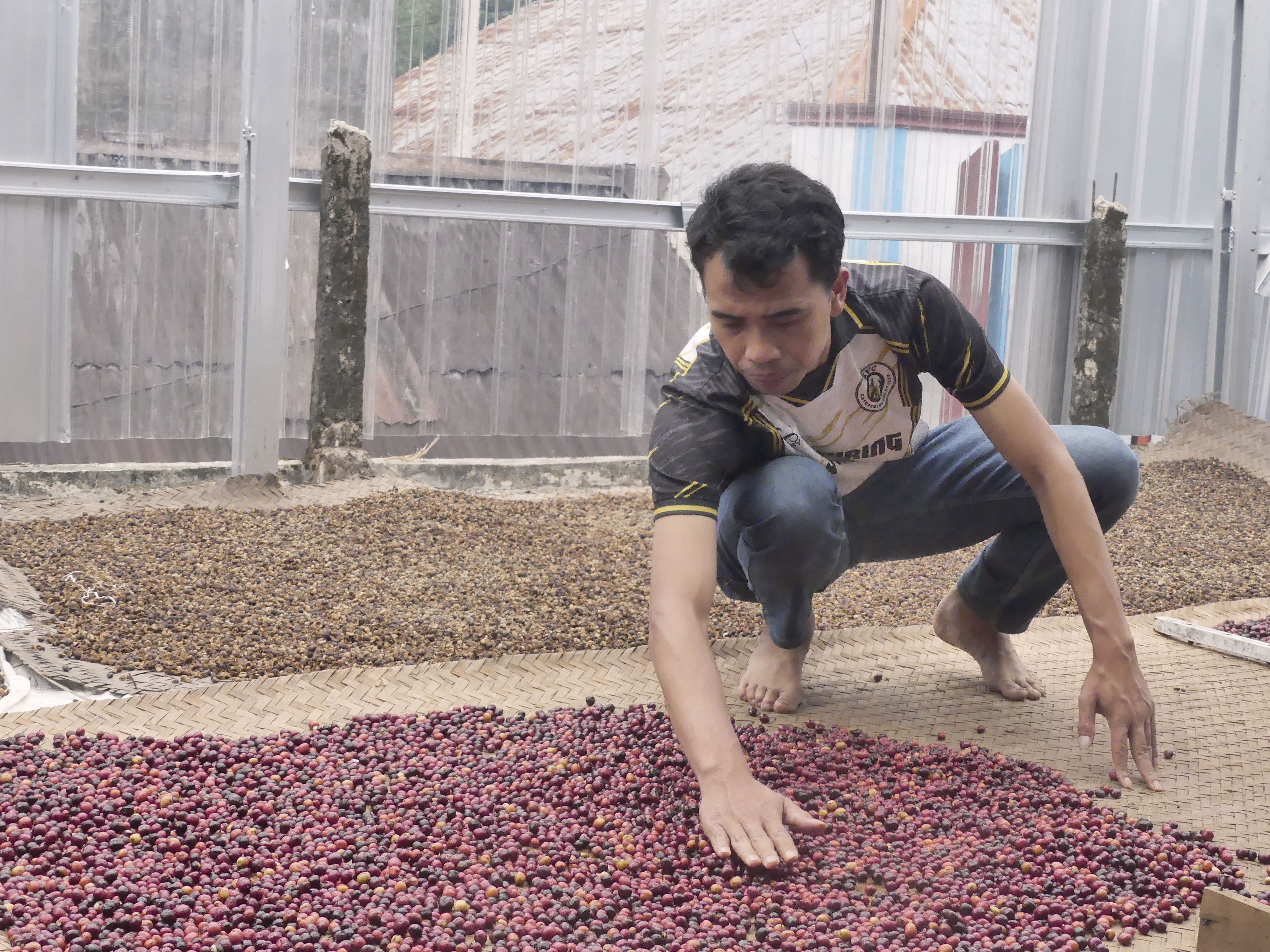
solar drying dome in Sawangan village
In Sawangan, farmers don’t rely on coffee as their sole commodity. The sugar palm, which grows abundantly in the forest, provides a significant economic contribution. The majority of residents work as palm sugar farmers. Uniquely, limited road access to the hamlet has given rise to a unique adaptation: the sugar is stored in liquid form, which can last for months. New stocks of liquid sugar are printed to be sold when urgently needed or when prices rise.
There’s an interesting common thread running through these components: coffee, sugar palm, and civet. All three form a systemic feedback loop worth examining. The existence of civet coffee presents opportunities for premium product development. On the other hand, the sugar palm’s economy is dependent on the civet’s survival: this animal disperses seeds for tropical plants that have served as a natural sweetener for the Indonesian people for centuries. Protecting the civet isn’t just about emotional affection for this adorable animal, but also about ensuring the feedback system it helped build doesn’t collapse.
Non-linear patterns like those in Jalatiga and Sawangan Ronggo are common in other villages, demonstrating that agroforestry farmers contribute to broader ecological outcomes, including habitat provision. Therefore, it is appropriate that such practices receive adequate incentives, whether through price appreciation for their products, access to premium markets, or other forms of recognition that can improve farmers’ well-being. This way, maintaining biodiversity and landscape sustainability is not seen as a burden, but rather as an investment that provides tangible economic benefits to the community.
The irony that opens up opportunities
If agroforestry landscapes provide an ecological foundation, the next challenge is ensuring that the economic benefits are enjoyed inclusively by the community. In Karanggondang, Tutur (52) expressed his concerns. As a farmer and hamlet head—a respected figure in his community—he harbors hopes that coffee can stimulate the creative economy for the village’s youth.
He saw the opportunity, but hadn’t yet found a path forward. Until now, the villagers had tended to sell all their coffee harvest, while being forced to purchase manufactured coffee for their daily consumption. In fact, they used to roast their own coffee using a pan, a traditional skill that has now nearly disappeared.
This situation could actually be transformed into an opportunity: the emergence of a form of entrepreneurship in the form of ready-to-brew ground coffee production. Young people are the most potential group to take advantage of this opportunity. The emergence of downstream businesses could even have a significant systemic impact, creating jobs and boosting the local economy.
Young people are generally more open to accessing information as a fuel for creativity. In turn, simple innovations can change many things. This is evidenced by Muhammad Ridholah (33), a coffee roaster in Mendolo Village, Lebakbarang. His persistence in creativity resulted in a simple roasting tool, which then led him to venture into offering a roasting service. The response was positive, with his neighbors appreciating him and becoming regular customers.
Thanks to this endeavor, Ridho not only reaped economic benefits but also helped revitalize the local coffee culture in his village. He now has a roasting unit serving customers from various areas around his village. Ridho’s success story can inspire young people in Karanggondang and other villages that limitations can actually give rise to innovations with multiple benefits.
Added value without clearing land
Rame (30) looked amazed as he tasted the coffee we brought, a carbonic macerated Arabica from Gayo. His face revealed a look of astonishment that a particular processing method could produce such a magical flavor. This coffee produced a strong berry flavor, balanced acidity, and a thick body. This was his first experience discovering the unique taste and aroma of an experimentally processed coffee.
Armed with the training held last month, Rame and the farmers in Garung hamlet have taken the first steps to improve the quality of coffee processing in their community. He chose the natural process and can’t wait to taste the results. His dream might come true in about a month. Coffee processing is not simple: red picking, controlled drying, and rigorous grading and sorting. Furthermore, the natural process takes a long time to dry.
In Lemahabang Village, Sawal (54) experiences another challenge. Much of the robusta coffee he processes is broken due to the lack of standard hulling equipment. At this point, in both Rame and Sawal’s cases, introducing technology could be a significant solution. Infrastructure such as drying domes and production equipment like hullers and graders could increase efficiency without sacrificing quality.
Technology alone is not enough to increase efficiency. What often happens is that both farmers and processors bear a double burden: tending the plantations and processing the harvest. Therefore, a clear division of roles is needed. Farmers are encouraged to focus on plantation management by implementing best practices to produce the best coffee cherries. The end result is perfectly ripe coffee cherries.
Afterward, processors take over: processing the cherries into premium coffee beans. Without the burden of processing, farmers have more time to increase farm productivity. Without the demands of time on the farm, processors can experiment with various processing methods to create unique flavors, like the Gayo coffee Rame tasted—coffee that can be sold at a premium price and boost the popularity of the producing region.
At some point, this division of roles requires local institutions (such as farmer groups or cooperatives) to ensure that the economic value added from post-harvest management flows equitably back to farmers. Without this, the role-sharing scheme has the potential to create unequal incentives. Ultimately, systematically improving post-harvest management is a crucial strategy for farmers to gain added value without having to expand their land, which further pressures forest areas.
After four days of traveling from village to village, we realized that coffee clearly cannot be the sole savior for the Javan Gibbon. Conservation occurs when human interests and ecological needs meet in a landscape whose interactions are non-linear. Coffee is simply the medium that makes that encounter possible. The rest is the role of all of us as part of the supply chain: farmers, processors, roasters, coffee shop owners, brewers, and, of course, the drinkers. A sip of coffee is no longer about increasing bodily awareness ( consciousness ), but also about assuming responsibility ( conscientiousness ).
This article translated from original blogpost published here : https://swaraowa.blogspot.com/2026/06/owa-coffee-agen-konservasi-di-lanskap.html