By: Nur Choiriyah Merdekawati

participants of 2025 Gibbon field course in Sokokembang
November 3–7, 2025, the cool air of Sokokembang Forest, nestled in the heartland of Javan gibbon habitat, Pekalongan, Central Java echoed not only with the calls of Javan gibbons but also with the laughter and conversations of a group of passionate learners. SwaraOwa as a local conservation initiative committed to protecting primates and their habitats, hosted the 12th Gibbon field course 2025, a five-day and four-night field-based training designed to strengthen participants’ skills in gibbon research and population survey methods.
The program brought together a diverse mix of students, researchers, and conservation practitioners. Total 21 participant consist of Mentawai team, Siberut National Park, KSP Macaca UNJ, “Lutung” FSP Universitas Nasional, KPP Tarsius UIN Jakarta, Yayasan Konservasi Hutan Harimau, Green Community Universitas Negeri Semarang, Yayasan Palung, The Biodiversity Society, Sanggabuana Wildlife Ranger, KP3 Primata UGM, Yayasan KIARA, Yayasan Cikananga Konservasi Terpadu, BOSF Nyaru Menteng, Balai KSDA Jawa Tengah. These participant united by their curiosity and dedication to understanding gibbons, one of Indonesia’s most iconic yet vulnerable primates. The main objective was to build participants capacity in gibbon monitoring techniques while fostering a spirit of collaboration and shared learning among those working to conserve biodiversity.
On the afternoon of November 3, 2025 participants arrived at SwaraOwa field stationf, a small but vibrant hub surrounded by forest- coffee trees and the songs of forest birds. The field station just recent facilities , located at the edge of Sokokembang Forest, in Petungkriyono Distrcit. is not only a research outpost but also a social space where community-based conservation meets everyday life. A center for conservation, education and coffee retreat situated in the habitat of Javan gibbon.
The first day was dedicated to introductions both among the participants and with the SwaraOwa team. These sessions went beyond simple name exchanges; everyone shared their backgrounds, motivations, and connections to this training as well as conservation. In the last of this session, SwaraOwa as a facilitator presented their organization’s journey, from early research on Javan gibbons (Hylobates moloch) to ongoing projects linking science, ecotourism, and community empowerment.
The atmosphere was warm and inclusive. Many participants admitted that this was their first time primate training. “It was the beginning, but it’s really interesting,” said one student, “Wait, tomorrow must be more interesting” as others replied.
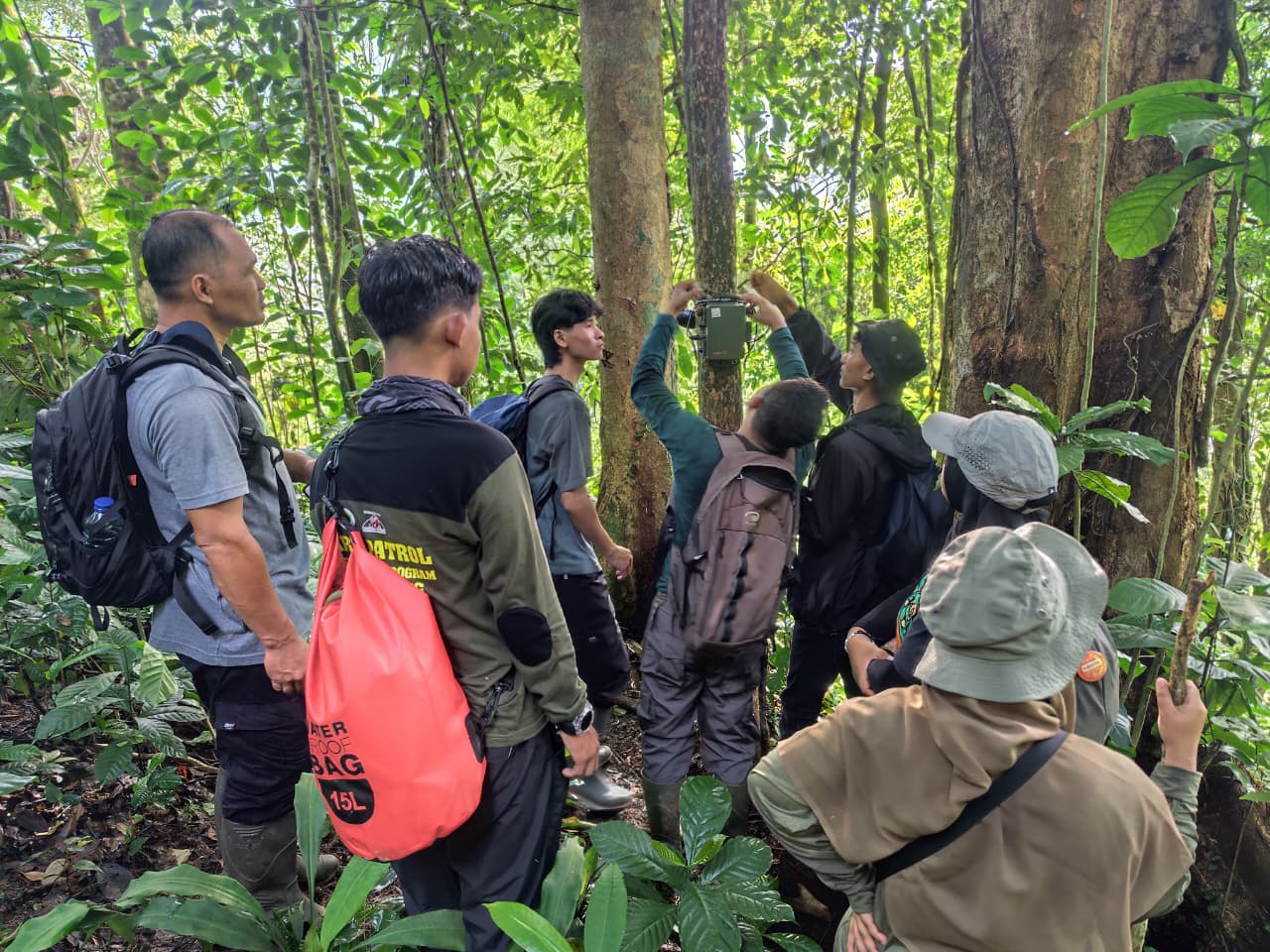
participants in the field introductory for bioacoustic device for gibbon monitoring
The second day marked the official opening of the training. The ceremony began with a welcoming speech by the Administrator of the Forest Management Unit East Pekalongan (Perhutani KPH Pekalongan Timur), who highlighted the importance of collaborative conservation efforts between researchers, local communities, and forest management agencies. His remarks underscored a key message: the survival of gibbons and forests depends on partnerships built on trust and shared goals. Followed with some advice by Subdistrict Leadership Forum of Petungkriyono.
The day continued with a technical lecture by Arif Setiawan, introducing participants to the Vocal Count Triangulation (VCT) method, a basic technique used to estimate gibbon populations through their territorial calls. The session combined theory with field occurence, helping participants visualize how data points from gibbon calls can be transformed into population density estimates.
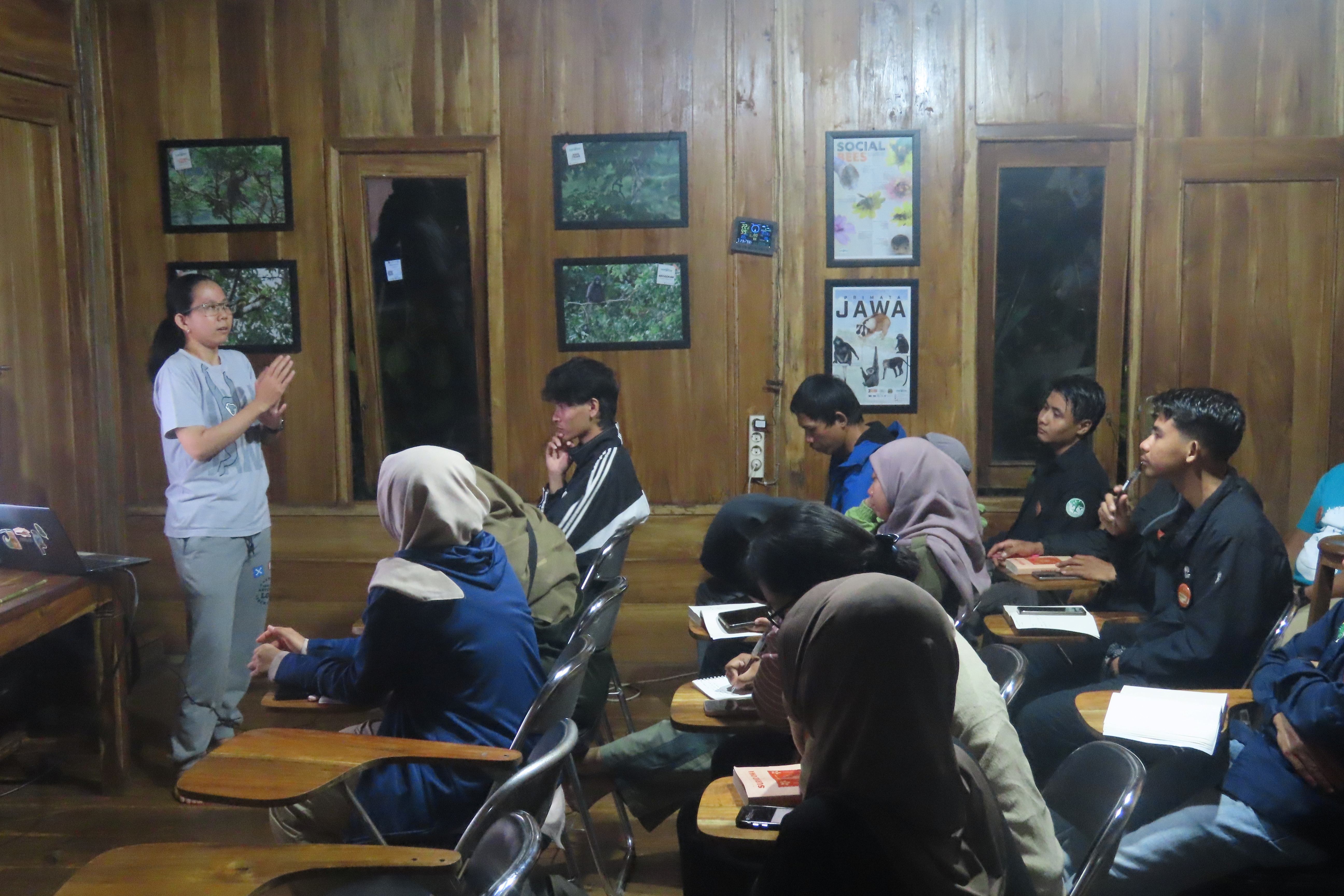
Celia Felicity delivered a presentation on how the Indonesian Small Species Specialist Group contributes to species conservation efforts
Next, Kurnia Ahmadin presented a session on field data collection, focusing on observation skills, navigation, and consistency. Including key elements for reliable survey results. Later in the evening, Celia Nova Felicity representing the Indonesian Species Specialist Group (IdSSG), introduced participants to collaborative data management and the importance of standardizing the threatened status of species in Indonesia. By the end of the day, participants were divided into small groups to prepare for their first field exercise in the next day.
The third and fourth days took the participants deep into Sokokembang Forest, home to one of the few remaining populations of Javan gibbons in Central Java. Each morning began in the dawn, as teams hiked into their designated observation points. The forest slowly awoke around and the hauntingly beautiful duets of gibbons began to echo from the canopy.
Armed with GPS devices, smartphone and data sheets, participants set up the passive voice recorders on the trees, then continued by practicing the Vocal Count Triangulation (VCT) method, noting call times and compass bearings to estimate group locations. These early hours were filled with focus and quiet awe until 10 a.m, a perfect combination of scientific rigor and spiritual connection to nature.
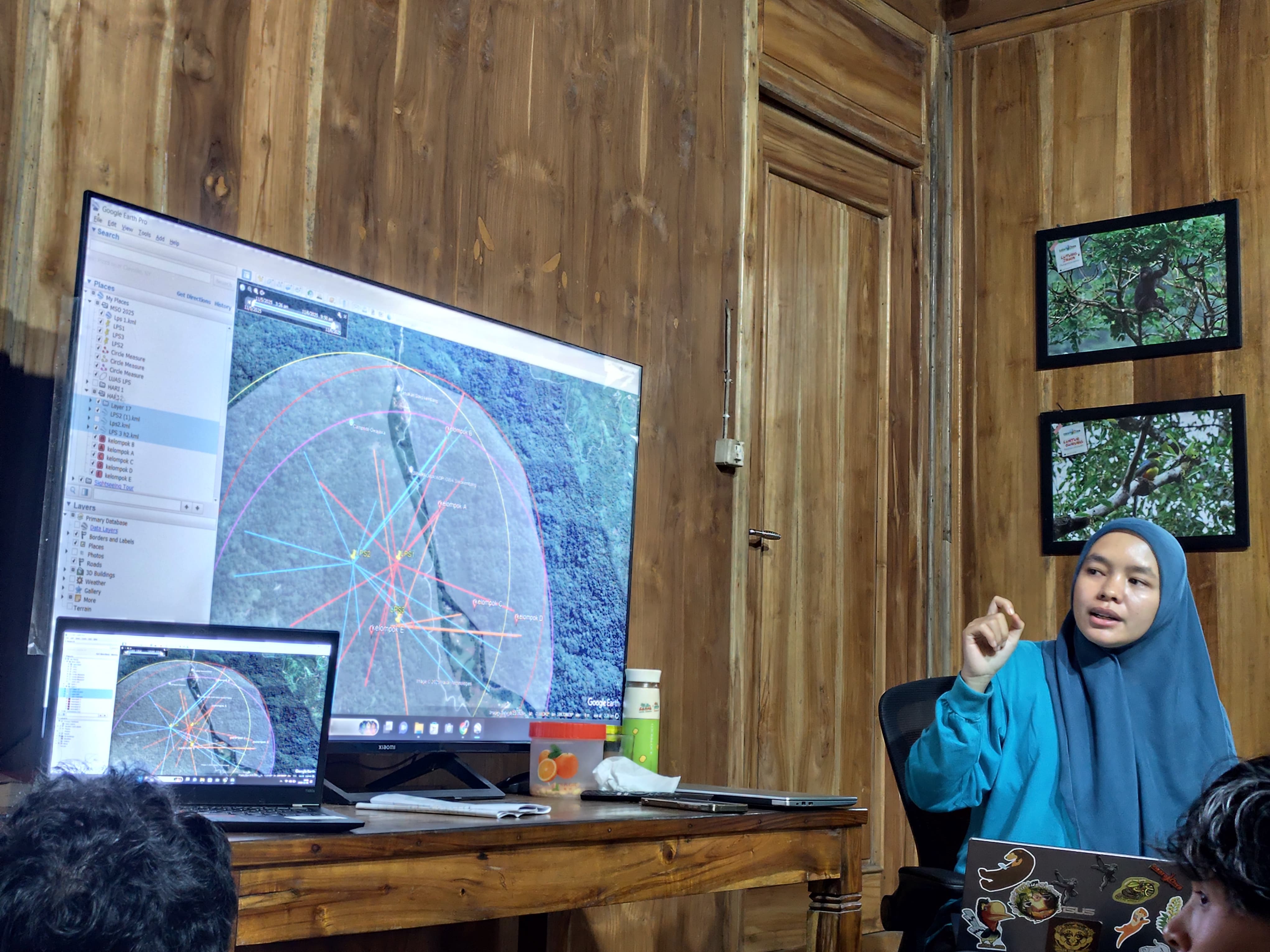
Aoliya-SwaraOwa introduce how to do analyze gibbon popuplation based on vocal count triangulation method.
After returning to classroom, the day continued with a lecture on bioacoustic monitoring led by Nur Aoliya. The session introduced participants to the basics of sound analysis, including how to use software such as RavenPro to visualize and interpret animal calls. For many, it was their first time seeing gibbon songs transformed into colorful spectrograms visual vocal fingerprints of the forest’s hidden voices.
The learning did not stop there. The afternoon sessions were filled with discussions and data analysis, including how to use Google Earth Pro to map call points and triangulate gibbon locations. Each group worked with their own data, testing different analytical approaches and comparing results.
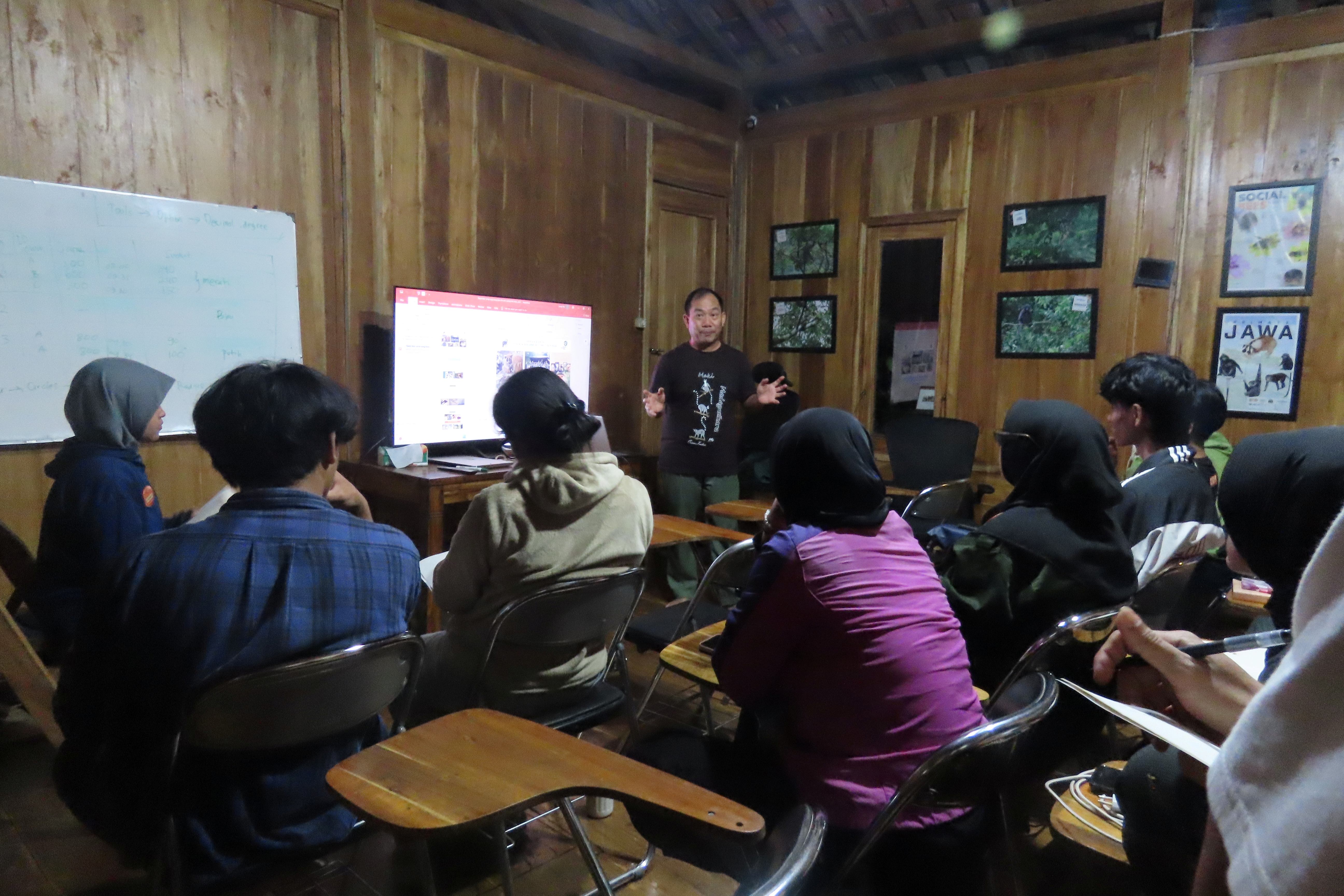
Dr. Long Tha Ha introduced Vietnamese primates and the ongoing conservation efforts.
Adding to the global perspective, two guest speakers from Vietnam, Dr. Long Tha Ha, a Vietnamese biologist and conservationist who won the 2025 Frankfurt Conservation Award, now lead Frankfurt Zoological Society Vietnam program, joined the training in the evening, and Mr Tuan Van Bui, a primatogoist who run primate watching tour business cross Vientnam. Dr. Long shared his experience in primate research across Southeast Asia, highlighting both the similarities and differences between gibbon species, research conditions, and community background in Vietnam and Indonesia. Meanwhile, and Tuan Van Bui spoke about the potential of primate-focused ecotourism as a conservation tool, inspiring participants to think beyond science and consider sustainable livelihood models linked to conservation through his program known as HIVOOC, Vietnam Wildlife Adventure Tours.
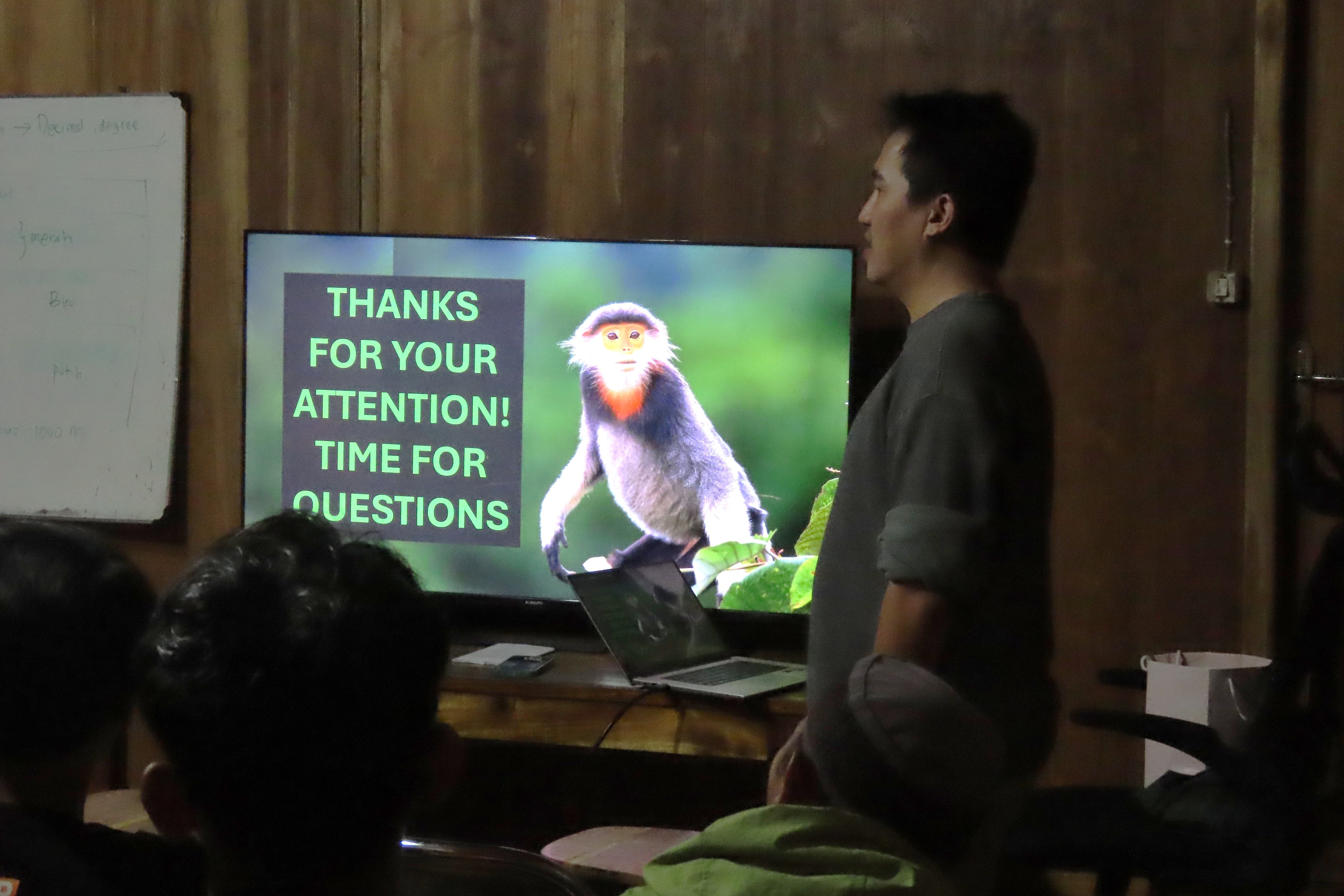
Tuan Van Bui introduced HIVOOC, his project focused on developing Vietnam Wildlife Adventure Tours
After returning from the field observation, the fourth day blended intense analytical work with moments of relaxation. Participants refined their VCT and bioacoustic data analysis, assisted by mentors and fellow trainees. Some groups compared their manual calculations with digital maps, while others debated over possible errors or interesting patterns found in the field data.
As the sun set behind the forest ridge, the academic discussions gave way to laughter and light-hearted conversations. The evening’s “free session” turned into a spontaneous corn-roasting night, where participants gathered around a small fire, sharing stories, local songs, and reflections from their time in the forest.
“This is not just a training; it feels like a small conservation family,” one participant remarked and indeed, by this point, the group had formed strong bonds built on shared purpose, field challenges, and the joy of learning outdoors.
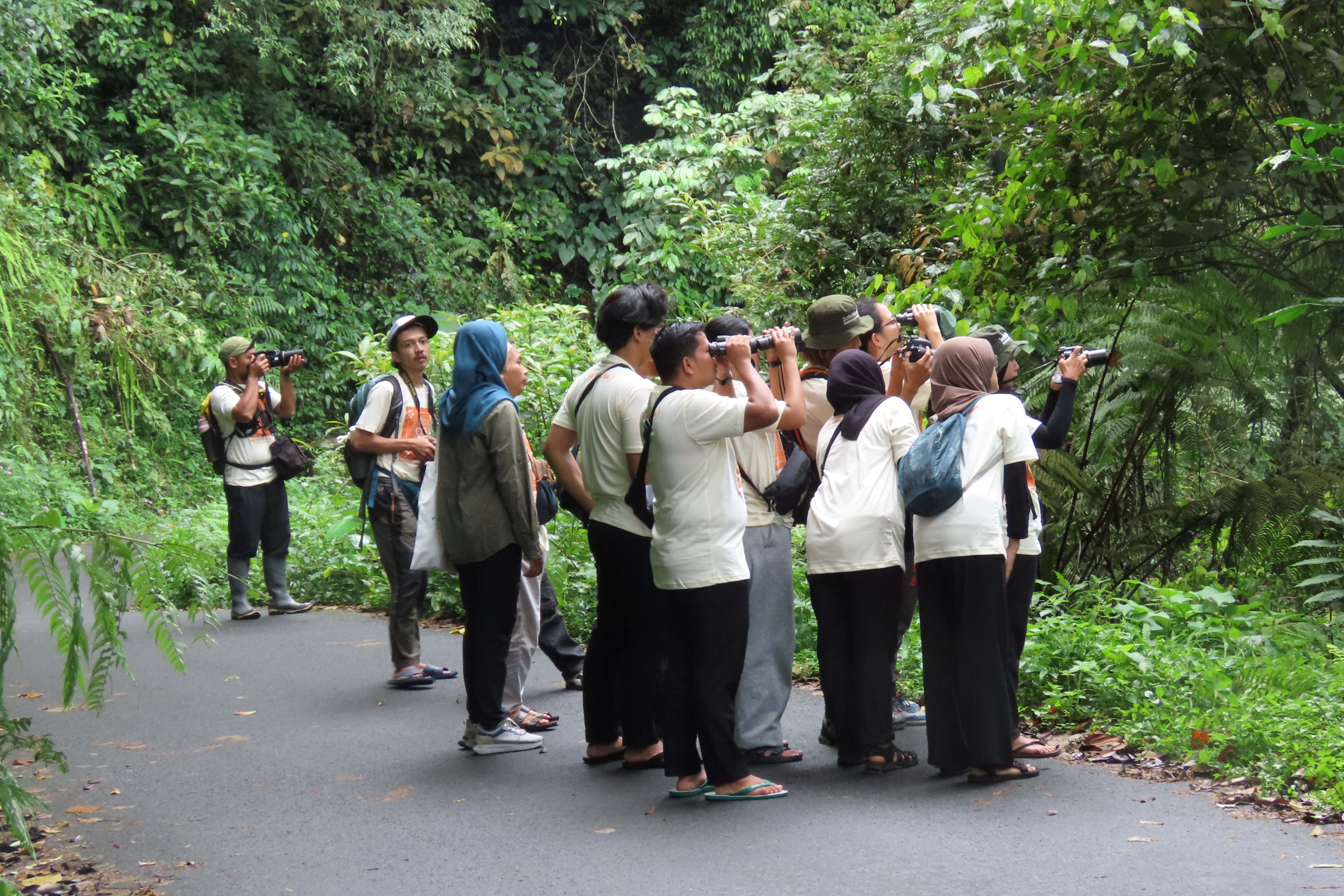
Primate Watching-gibbonning in Sokokembang Forest
The final morning began with a relaxed yet inspiring primate watching session along the forest edge. Participants used their binoculars and camera’s skills to locate gibbons, leaf monkeys, langurs, and birds. It was a reflective activity, a moment to reconnect with why they came in the first place.
Later, each group presented their findings, showcasing maps, analysis results, and reflections on what they had learned. The presentations were not just technical reports but narratives of growth, how theory met practice, and how teamwork turned uncertainty into understanding.

a gibbon spotted during the training course
The facilitators gave constructive feedback and celebrated the best-performing team, whose field data and analysis stood out for accuracy and creativity. The event then moved to a closing session, filled with words of appreciation from the organizers and participants alike.
As the certificate ceremony ended, the participants packed their bags, exchanged contact information, and took one last group photo under the forest canopy. The air was filled with gratitude, for the knowledge gained, the friendships formed, and the renewed sense of purpose.
The 12th Sokokembang field course 2025 was more than a technical workshop; it was a living classroom where science, nature, and community intersected. It provided a rare space for young researchers to learn directly from practitioners who have dedicated their lives to primate conservation. By integrating field methods, data analysis, and cross-cultural exchanges, the training embodied SwaraOwa’s holistic approach combining research, education, and community-based conservation.
As the last jeep departed from swaraowa center, the forest slowly reclaimed its quiet rhythm. Yet, for the participants, the echoes of gibbon songs would linger as a lasting reminder that every sound in the forest carries a story worth studying, protecting, and sharing.